
water world
an unpublished piece from last winter
In honor of New York City’s pools opening this Saturday, I’m sharing an unpublished piece I worked on from 2024-2025 about our municipal pools, and also our non-municipal pools. I’m publishing it partly because it was a lot of work, and I think about it whenever I go swimming, and it ruins my swim entirely because I feel bad that it went unpublished. But I’m also publishing it because it captures what our city looked like to me a few years ago, and I’m hoping we see a very different version of pools this summer. So far, I think we will.
I have adjusted dates and tenses when necessary, buy beyond that left it untouched.
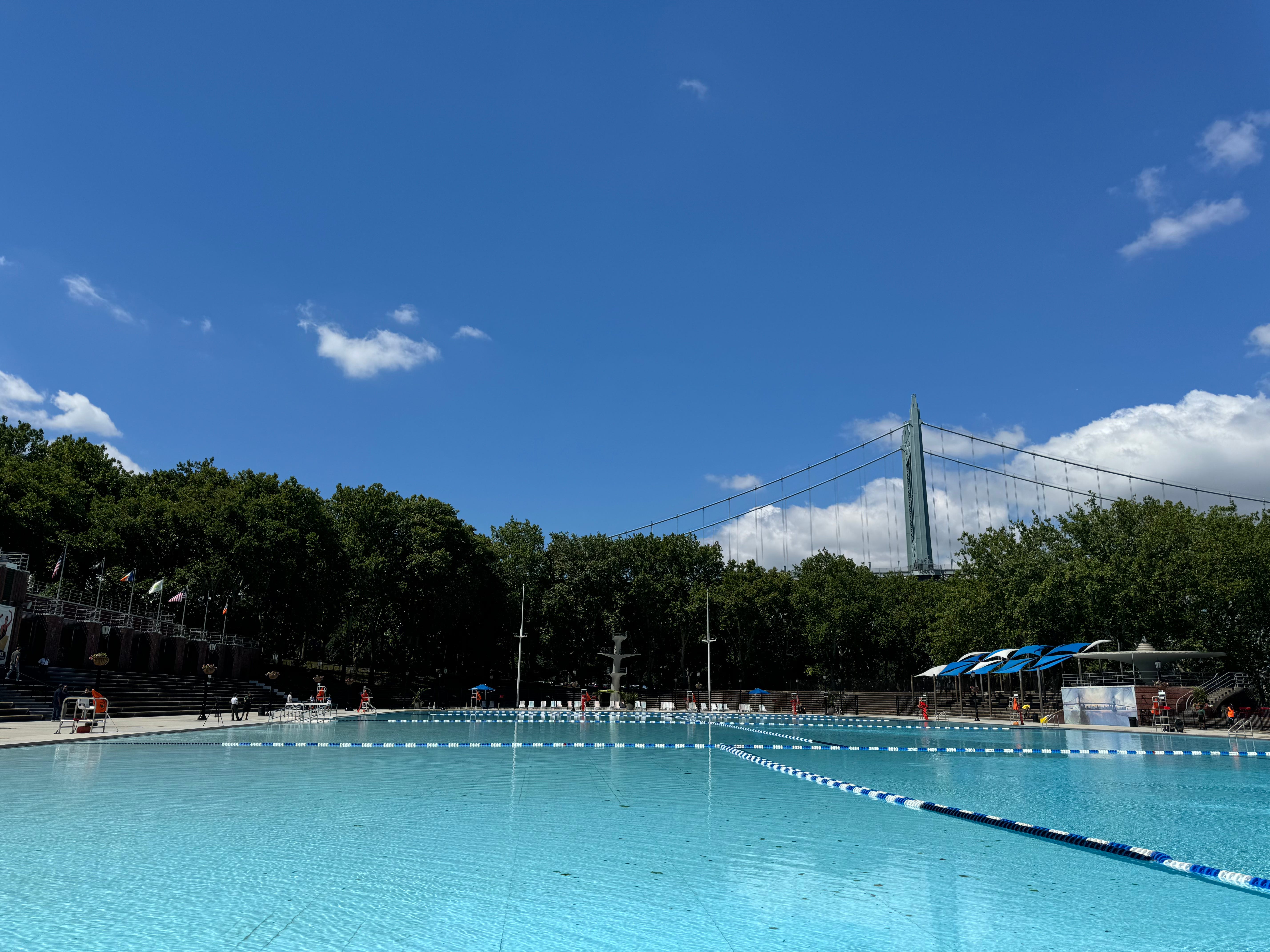
The Astoria Pool was reopening. It had been closed for several years - a combination of Covid and construction - and this, the 2024 return, was meant to be a special occasion. The reopening was also then-Mayor Eric Adams’s first official visit to any of the city’s pools during his tenure, and though he declined to join the Parks Commissioner for the ceremonial first splash into the water, it seemed likely that it was his decision to bring along a high school band to play “Empire State of Mind” on horns while it happened.
Adams did not seem at home by the water, and his message during a brief speech - “Pools are the economic driver of New York City” - made little to no sense. But the rest of the delegation sent to reopen the pool was jubilant. This was, after all, a concrete victory, an actual restoration that finished, which is more and more rare in New York’s scaffolded landscape.
Following the ceremony, the official hours of the city’s pools commenced - 11am to 7pm - and the line to take the first dip of summer stretched blocks and blocks. Those of us unwilling to wait climbed instead to the deck across the top of the lido, looking out over everything our city, it turned out, could do.
“18 million dollar restoration,” I heard an elderly man wearing compression socks say to a young couple he didn’t seem to know, “I never seen anything like it. Just beautiful.”
In truth it was. Built as a Works Progress Administration initiative in the 1930s, the pool flows out through Astoria Park, a spectacular view of the RFK Bridge making Manhattan look small. Everything about the 12 WPA pools across New York City is gigantic, and the great span you feel, whether deckside or floating within them, has an almost loving feeling of situating you. It’s clear that you’re still in New York City, no matter how far away you let yourself drift in the water. Even on the deck, I felt that drift, until a voice from below summoned me back. Debra, an Astoria Pool devotee I’d met several months earlier, was calling my name from the water.
“Everyone’s here!” she yelled up, gesturing towards the water, and she meant the Astoria Water Walkers - a group of mostly seniors who spend each summer walking enough laps in the pool to celebrate with a big party at the end of the year. “We get to use the senior entrance,” she explained, “so we cut the lines.”
Debra’s joy shot up to the deck, and probably to the top of the giant trees above us in the park as well. The Walkers had been worried that the pool wouldn’t reopen, and the last-minute announcement that it would was a great relief. In fact I had met Debra back in the winter, when she seemed to be looking for other options, should the worst happen to the pool where she’s been swimming for most of her life. We had both just sat through a presentation about the history of New York City pools sponsored by Plus Pool, a nonprofit that has spent the last 14 years raising money and awareness for the fact that they want to build a pool in the East River, using East River water. That last part is crucial, since it makes absolutely no sense - until they explain it, which, when they do, also makes no sense.
Perhaps for this reason, Plus Pool has pivoted to becoming sort of an all-around swimming enthusiast group, situating themselves as the de facto pool and water experts of the city. Hence the lecture, which was less of a lecture than a series of facts gathered from Wikipedia pages on the subject of swimming, but did cost $24, which would be donated to the organization. For the audience’s part, most people did not seem to know that New York City had pools at all. In the mingling portion after, during which we were encouraged to buy drinks to further support Plus Pool’s efforts, I felt a rap of my shoulder, and there suddenly was Debra. “Excuse me, do you swim?” And I said, yes, I do, and she sighed in relief. “I’m just trying to figure it out – —who here actually swims?”
*
This is the grand scheme of Plus Pool: it’s a floating pool, in the shape of a plus sign. The reason for the shape is “design,” and this is made clear at every Plus Pool fundraiser. The plus sign, whoever speaking for Plus Pool - usually Kara Meyer - will note, is positive. “Particularly now, when there’s all this hate going around,” Meyer had told a crowd of potential donors back in January 2025, “design matters.”
For designers of a certain Obama-era mindset, this idea - that what they do really matters, perhaps more than anything else - is central to their operation. It is often also wildly blind to anything outside of the design being inflicted on whatever field they’ve chosen. An inaccessible pool floating in unsafe water has no need to exist, but if you were to build such a pool, you’d think you’d notice from almost every other pool in the city, and the world, that four straight lines separated from each other is not the ideal shape for swimming.
But the shape of the pool is central to the organization, presumably because it’s all there really is to the pool at all. In fact, back in 2010, when the legendary four designers of Plus Pool first conceived of the idea, they did so by drawing a plus-sign and calling it a design for a pool. That was about it, in terms of creation. But the myth holds crucial, despite the departure of one original founder who felt the nonprofit was getting too white and too rich to achieve an equitable plus-sign. But he isn’t really discussed anymore, probably because that sort of thinking is sort of a downer. And Plus Pool has no intention if not sheer positivity. One is meant to see the floating plus sign from, say, an office building in Kips Bay, and be brought joy, even inspiration. There are so many things one can add, with the existence of a plus sign, that is doesn’t really matter what sort of things one wants to add, or is capable of adding. The more, of whatever, the merrier.
“What we’re getting rid of is just this overall ‘umbrella of No,’” Meyer told me back in 2024, speaking directly to the idea of changing protocols for measuring whether or not water was safe to swim in. “Like, ‘Nope! This doesn’t work!’”
It doesn’t, but that’s beside the point. For Meyer, it was about “moving the needle of change” so that, even if Plus Pool fails, due to not working, another organization might be able to use the lowered standards to build something that succeeds. Accessing the water by swimming, she said, was “the first step” in many that will ultimately lead to better conservation. When I pointed out that it seems like the first step was the Clean Water Act, which hasn’t actually allowed us to swim in the rivers yet, she still maintained that “awareness” of the possibility of swimming in the river is the most important thing Plus Pool does, now. (Forget about the pool for a minute, or forever.) In fact, she says, “the most discernible environmental benefit” of Plus Pool “is making that connection to New Yorkers.”
“This is the greatest city in the world with so many things,” she said, “and the only thing we really can’t do here is jump in the river safely.”
*
There are actually a lot of things New Yorkers can’t do, but swimming on a whole does rank as one. Not in the river, just at all. As of 2017, over a fourth of students in New York City did not know how to swim. In a passionate 2022 op-ed for the New York Times, Mara Gray noted that within these statistics, non-white students were most at risk, with one in three Black or Asian students unable to swim. For their part, Friends of Plus Pool has taken this problem to heart, offering free swimming lessons year-round, mostly in public indoor pools. The Department of Education does this too, and the Let’s Swim initiative promise to build two new pools in public schools and renovate seven existing school pools back in 2024 nodded towards the city’s understanding of this crucial lack.
Teaching children to swim is essential. Of the annual 1.7 million visitors of the city’s outdoor pools— - which are only open for nine weeks out of the year—the majority of patrons are children. According to the Parks Department, this makes sense: children are free during the day all throughout summer, having no school or job to go to.
But these statistics are not new. The history of pools in New York, and in fact in America, is the history of children being in pools, generally while adults decide in the background whether or not that’s a good thing. In Jeff Wiltse’s excellent Contested Waters (2007), which tracks the history of swimming pools in the Northeast, the battle between scoundrel youth and working men and women trying to relax begins in the original bathing pools of urban America and never ends. Today, swimmers of every age above teenage still speak of youthful swimmers as if they might simply overtake them. “Have you heard of this game, Marco Polo?” one of the Astoria Water Walkers asked when I brought up kids at the Astoria Pool. “It is a menace. They are everywhere.”
Anyone who’s spent time in them can tell you that New York’s pools really do belong to children. They open the day school ends, and efforts to keep them open longer into the fall, particularly as September and October days get hotter and hotter, have mostly failed due to collapse of interest once classes start up again. The public pool steps in for school, in practice as much as theory: the DOE provides free lunches at pools every day, and lifeguards in place mean that parents can feasibly let children of a certain age spend time there alone, giving much needed structure and activity to summer days.
In fact, it’s the pool as municipal childcare that keeps the idea of funding the pools at all afloat for many lawmakers. Pools play a near-mythical role in keeping city teenagers “out of trouble.” Every official I spoke to for this article mentioned some idea of pools as that which keeps the perennial troubled youth out of all that city trouble. As one Parks employee put it, “It doesn’t matter how tough they are, you watch them get in the water and just become a kid again.”
It’s a precious concept, but hear it enough times and the unspoken truth unsettles. The insistence that jumping into a pool can turn a city kid into a bundle of soggy joy relies on the belief that there’s something threatening about that kid to begin with. A shocking number of New Yorkers in charge of youth, from Parks to Education, seem to begin their plans for their departments with the idea that the majority of young people’s existence has the capacity to turn into something impossible for them to manage. Where these plans often end up, after countless budget cuts and rearrangement of fundamental priorities, is that the management must begin before anything impossible even happens. That is, the world for many New York City children begins with discipline, rather than encouragement.
This decision affects everyone, whether they realize it or not. Entering a public pool in New York takes so long not only because of lack of staff, but because the admission involves a strenuous investigation into each person entering the pool. Your bag may not contain food, or any pool toys or flotation devices of any kind. Cell phones are not allowed on deck, and neither are most anything else besides water, a towel, and books. If a person is wearing a t-shirt, that t-shirt must be white, for fear of “gang-related” colors. And no person may enter the pool without wearing a swimsuit. This last rule is perhaps the most outrageously enforced. Visit a pool often enough and you’ll notice the force with which Parks Department employees, many of whom got their start in law enforcement, check to make sure New Yorkers aren’t trying to sneak in in underwear or street clothes. Most often, it is teenage boys of color who are most invasively checked, made to show the lining of their swimming trunks to a stranger in front of their whole neighborhood.
To enter the pool in the city of New York is to find instant relief, and the first dive into the water after a long line almost always feels worth it; the frustrations of the wait float away on first contact. But it is not right to make people go through this humiliation and frustration to find so much relief. It is no wonder that the city fails to provide funding and care to what many officials seem to see as a place to store unwanted people during the summer months. It is only after they prove themselves worthy of joy - by splashing into a pool in just the right way - that the city decides to let them relax.
*
Were it possible to build on the waterfront of New York without the involvement of the city itself, wild projects like Plus Pool, and the $260 million failure of Little Island, which three years into pained existence is still desperate, according to a recent Times article on the Island’s slew of disjointed summer programming, to figure out how to get people to visit it, might simply annoy. But the waterfront exists in a complicated legal mix of public and private, and in some way, we the taxpayers are always paying for it. The reasoning for this is almost poetic: much of the waterfront as we know it wasn’t supposed to exist. As Kurt Schlicting tracks in Manhattan Waterfront (2018), most of the extension of Manhattan was built by selling water-lots, or swaths of water to be turned into land, to private entities, who then held control of these areas and essentially leased them back to city; the idea was that construction of anything at all was essentially impossible without private money, but necessary nonetheless. It’s the same mentality with which Robert Moses took such control of our private-riddled city, and the idea that a person can do whatever they want with something they built, even though they built it on a massive, public entity, is in many ways the resounding narrative of three centuries of New York real estate.
Maybe that’s why the influx of things that no one in the city wants, can reasonably get to, or ever asked for being built along our shores infuriates so much. What’s more, as Schlichting notes, these particular public-private partnerships almost always end up being a publicly-funded space exclusively for the rich, with prominent examples like Battery Park City and the High Line leading the way.
The High Line, which effectively belongs solely to tourists, was built by another nonprofit with a wild dream, and its founders have been active in backing Plus Pool, appearing at numerous events and encouraging people to give as much as they can. 2025’s $16 million from city and state, it seems, will not be enough. This is hard to grasp when the details of the deal emerges: Governor Hochul, in compromise, has also allotted $60 million to build ten new public pools, here on land, and help pay for repairs in existing pools. The Plus Pool claims that if it’s ever built, it can hold 300 people at most—the same as existing Cool Pools, and intermediate pools in general. That’s at least $10 million less per real pool than imaginary pool. With less than half of Plus Pool’s funds given to build known structures, which hold the same number of people, in places that people can and go to, it’s hard to not agree that a disproportionate number of funds is going toward a demographic of the city that’s already captured enough of our money. If the city is so rightfully concerned about creating a city of adults that doesn’t have to be catered to with expensive gimmicks, the logical fix is to give to all youth what only a select few already have. The funding, that is, is terribly misplaced.
One of the most baffling parts of Plus Pool’s pivot’s desire to “raise awareness” among New Yorkers that we’re surrounded by water is the fact that we basically all already know this. New Yorkers already care deeply about their environment for the obvious reason that if we did not, we couldn’t live here anymore. Efforts to clean up the rivers have existed for decades, like the Billion Oyster Project. Advocacy for environmental equity like more trees in poorer neighborhoods, historically lacking in shade and fresh air, has taken off in recent years, just as much as the city-wide interest in our public pools. In what is perhaps the most lasting effort of the pandemic era, the average New Yorker understands that the public, outside world must benefit us all, or else. The pools are there for children, teenagers, adults, and the elderly - and we all want each other there, I think, no matter what our strictest rules put us through. This is a city where a person should be able to be born and live and die, after all. And a city where millions of people already do.
A few summers ago, I was taking a break between laps in the Sunset Park pool when a little boy swam up to me. Unable to reach the five- foot deep floor, he bobbed his head while treading water, determinedly swimming still in a place he was far too little to be in. “How many laps have you done?” he asked, and I was taken aback, because no one had ever spoken to me in the pool before. I told him - fifteen so far - and his little eyes went wide. “Wow,” he said, treading as casually as he could manage. It was exciting to be heroic to him, so I said I still had more to do, and he nodded sagely, but the nod put his head further in the water. A lifeguard blew his whistle, the boy and I looked up at him. “He’s calling to you,” I said, “He wants you to go back where you can stand.” Defiantly the boy attempted to stand in the deep water. The lifeguard blew his whistle again and I shook my head. “You should go back,” I said. “He’s worried about you.” “Ah,” the boy said, and swam dutifully back to his shallow water. I watched the lifeguard watch him, watched him settle back into his chair. When we were both satisfied I joined the other adults in our illegal lap swimming, dodging kids here and there who came over to what it so rightfully theirs, always watching for them, always, in one way or the other, worrying about where they would go.
As of June 2026, Plus Pool still does not exist, though they have built a prototype to continue testing - in the shape of a rectangle.