
wide open
Last week a group of centrists came together, once again, to deliver a document describing the ways in which their absence of action is actually very powerful. It has already been largely forgotten, not by design but by essence, for this is the main gist of the reaction to the rise of American socialism: forget. Over and over politicians running on nothing deliver the same ideas they have always delivered, and expect their voters to forget, to not notice, to ignore where these ideas have taken us. It is now undeniable that this no longer works, and in fact that it worked for far too long, and whether or not the latest scramble to contain this truth meant to accidentally name themselves after the Parent Teacher Association, to literally emulate the work of adults dealing with unruly children, is unknown to me, but their efforts will of course fail. They have already failed.
One of the more annoying tenets in these documents, whether they be on a campaign website of someone about to lose an election or on a consultant’s website offering services to help lose elections, is the idea that “government should work.” Promise to America takes it even further, as bold as they can possibly be: “Government matters, but it must work.” This doesn’t mean anything, and it doesn’t sound like it means anything either, but it makes perfect sense to them, because they are idiots. And they believe that we are idiots too, in the traditional sense, which is to say, incredibly simple folks. They believe that as long as “government works,” there is no need to explain how. This is worse than solid faith in a higher being you can’t speak to or work with, but can at least question, at least try to understand. This is not the 10am mass of Good Government. This is Sunday School. They preach not to the choir, but to very stupid children who can’t even read music.
It is good that we have rejected, finally, this god of government, that we have demanded true works and deeds instead of reliance on a higher power. It is also baffling. It has baffled everyone. Opposition forces in America have mostly been successful when driving people further into fascism, and thus the natural response of many precious morons paid to explain America is to assume that socialism, and its desire to make life easier for everyday people, is somehow in service of a twisted form of rightward thinking. On the other side, progressives who truly believe that this victory is the result of decades of hard work - unseen until now - believe that in fact these messages of affordability are the one easy trick that’s finally been tried. They point to the fact that the winning candidates of late largely seek to alleviate the constraints of the unaffordable world we live in now. That every single candidate running for every single office in the history of America has run on the idea that they will make the world more affordable registers just as little to this crowd as it loudly rings out to the other.
In both cases, we are looking only within, as we always do. But this is the question we must ask and answer in order to understand what it means that socialists are winning: is it really as simple as about making our own lives better? If so it is an American movement, birthed here, a way truly to make America better, maybe even great. But if it is not - and I do not believe it is - then this is a movement of Americans without nationalism. This is, in fact, an adult movement, a recognition of the world as it is and our place in it. It is a national response to an international understanding. And that dropping of nationalism, of America, has allowed us to find not the concept of New York, Colorado, Wisconsin, Missouri, Florida but the reality of them, the stuff of these places, the people underneath that which has ruled them. It cannot be made great or good or kind or bad; it can only be made, again and again, to move how we move. In other words, it is the people, not the nation, that have begun to lead.
What we do in our own country to stop imperialism has so far depended entirely on how successful those we are actually subjecting to our will are able to fight back. Had they been able to defeat those fighting them in Vietnam, the soldiers who came home from that war would have been treated historically as heroes instead of harbingers of our own hubris. There are very few movies about a Vietnam veteran who does not end up in some form of disarray, but the soldiers who went to Afghanistan and Iraq and everywhere else we’ve been in my lifetime have been quite literally turned into superheroes - Captain America and his America-backed crew. Those of us who oppose these wars have always been on the outside of American thinking because we did not believe in the virtues not just of the wars, but in the virtues of winning these wars. That is, we did not align with the mainstream ideal of a righteous nation who must prioritize its own victory above all. For this was the liberal drum beat of these wars: sad, but necessary.
It was only when these wars stopped seeming so necessary that this ideal changed. There is, to me, a great sadness in the way this understanding has changed over the last decade, in the fact that American thinking of these wars did not change by violence enacted by them but in fact a boredom with that violence, by the futility of their endlessness, instead of the outrage of their beginning. This is because I want to believe that public opinion can be changed by public morality instead of raw power. It is also because I want to believe that America can start something revolutionary, in this case an end to our own imperialism. But what I have to see clearly in order to understand what it means to be here, in America, is that as the oppressors we can only be reactionary to true revolution, that we are an asset, not a home, to it. Thus I have to accept that these movements, which seek to end our imperial reign, are in fact the success of so-called political violence - just not ours. And then I must decide if I truly am on this side that I have always believed myself to be on, that which seeks to end the dominance that makes my life as simple as it is, the result of victory over all others.
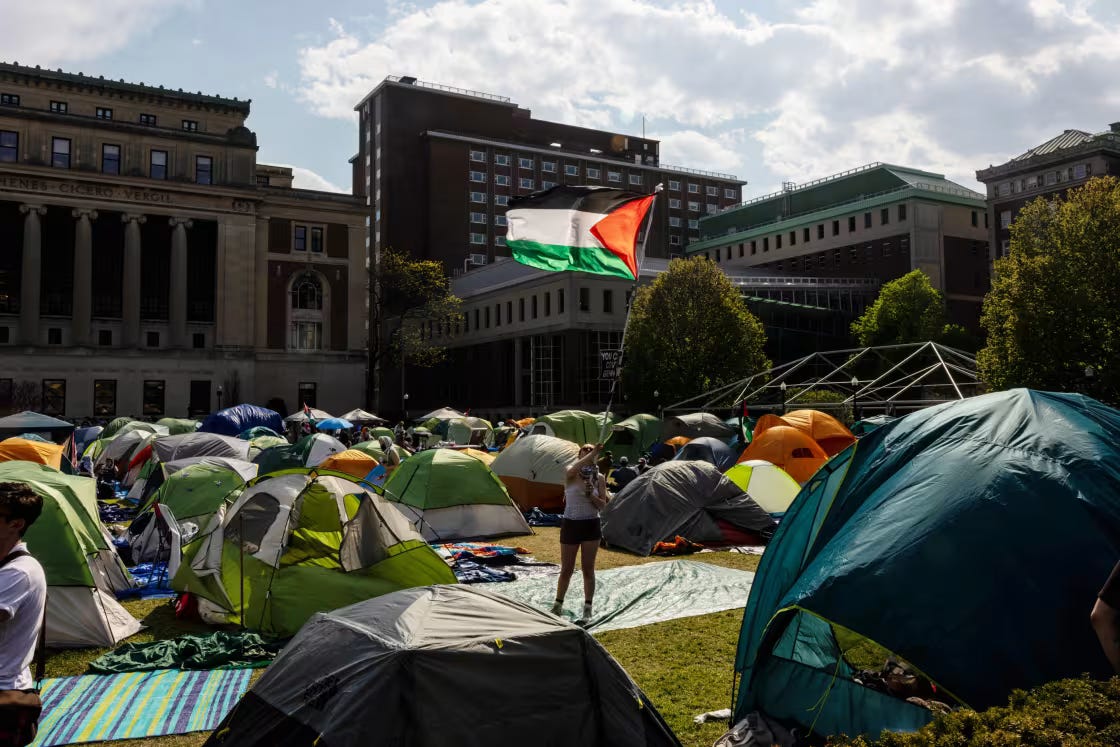
The answer came very quickly to many of us: yes, of course, that’s exactly the side we’re on. It was in fact a question we had already answered long ago, with no real use. What was different in the wake of October 7 was that assistance of true revolution from within our imperial core was now available to us. That is, we were not only morally on the side of the Palestinians, but able to connect ourselves to their revolution in the most widespread way yet seen. The years spent protesting, the courageous work of the students and their encampments, the clarity to lose a job in order to side with the revolution was not childish, silly, wishful thinking, nor was it a stand-in for some bolder, greater thing. These actions were the understanding that it is possible to stand with people across the globe, that it is possible to elevate a message they have sacrificed everything to send, that it is necessary to see yourself as a continuation of your values instead of just your place in the world. And of course the word for this is solidarity.
Imperialism builds walls. It locks in its own victors just as much as it locks out its enemies. We know that we are good, and we know that we are right. But we owe our ability to finally win to the destruction of these walls, these borders, these fences. It is this ability, to see clearly across the world, that has shown us where to stand.
Consider what it means to ignore this, to stay loyal to a higher power, refusing to touch down and learn from what’s growing beneath you. Too far above to understand that you’re being uprooted. Too high up to feel the ground shaking.
"We are the world, we are the children..." comes to mind. And we have work to do. Good to see the stirrings of action out in the country.